
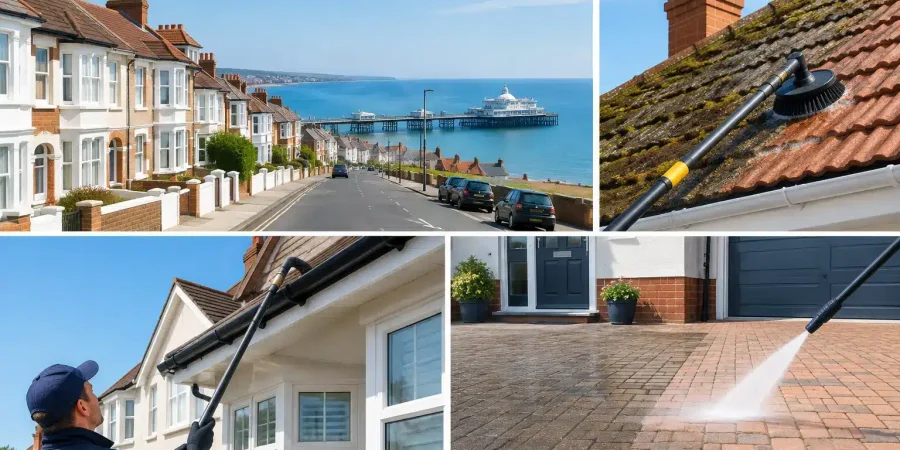
A forecourt is often the first part of a business premises people see, park on and walk across. This Eastbourne forecourt cleaning example shows how a planned professional clean can lift the presentation of a busy entrance without taking a one-size-fits-all approach to the surface beneath it.
Whether it is outside a shop, office, dental practice, small industrial unit or managed block, a forecourt has a hard job. It deals with tyre marks, footfall, wind-blown debris, rainwater, organic growth and the general wear that comes with being on display every day. Over time, paving can lose its original colour and the entrance can look less welcoming than the business or property deserves.
The answer is not simply to point powerful equipment at every square metre. A proper result starts with understanding the surface, the staining and how the area is used.
Eastbourne forecourt cleaning example: assessing the job first
Imagine a block-paved forecourt at the front of an Eastbourne commercial property. It is visible from the road, used by staff and visitors, and has developed green growth around the edges and joints. The main parking and walking areas have darkened with traffic residue, while a few isolated marks need more attention than the rest.
Before cleaning begins, the important questions are practical ones. Is the area block paving, concrete, tarmac or natural stone? Are there loose blocks, worn joints or damaged edges that need to be allowed for? Where will the water run, and how can the work be organised around customer access or opening hours?
These details affect the method. Block paving can usually be deep cleaned effectively with professional pressure washing, but it may need fresh kiln-dried sand brushed into the joints afterwards. Delicate wall finishes, rendered areas, fascias or signage near the forecourt need a lower-pressure approach, using soft washing where appropriate. The aim is a clean, even finish that respects every material around the work area.
That initial assessment also keeps expectations fair. Organic growth and general surface staining often respond very well to the right treatment. Deep-set oil marks, old paint or permanent discolouration can improve substantially, but their final appearance depends on how long they have been there and what has soaked into the surface. Honest advice matters more than making promises that no cleaning method can sensibly keep.
Preparing a working entrance properly
Commercial forecourt cleaning needs to fit around the premises. For some sites, the best option is to work before opening, after closing or in a quieter period. For others, the area can be completed in sensible sections so there is still a clear route for people who need access.
A professional job also means protecting nearby areas and working tidily. Doors, walls, drainage points and adjoining surfaces should all be considered before cleaning starts. This is especially relevant where a forecourt meets rendered walls or brickwork, as each surface may require a different cleaning method.
For a property manager, this planning reduces disruption. For a business owner, it means the forecourt can be refreshed without turning a normal working day into a problem. A cleaner entrance should feel like an improvement to the premises, not an inconvenience to customers.
The cleaning process for block paving and hard surfaces
On a typical block-paved forecourt, professional pressure washing lifts surface build-up from the paving and joints. The visible change can be striking: original tones become clearer, green staining is removed and the whole entrance looks sharper from the road.
The equipment, water flow and technique need to suit the surface. Too aggressive a method can disturb jointing material, mark softer paving or force water where it is not wanted. Too light a clean may brighten the top layer but leave organic growth behind. This is why the right machine is only part of the job. Experience and control make the difference.
Where moss, algae or similar growth is present, treatment may be used to deal with what remains below the visible surface. That helps slow the return of growth rather than only removing the top layer. It is a practical choice for shaded areas, north-facing entrances and places that stay damp for longer after rain.
Once block paving has been cleaned and allowed to dry, re-sanding the joints is often an important finishing stage. The sand supports the blocks, fills open joints and gives the surface a properly finished appearance. Skipping this part can leave paving looking incomplete and may affect how well the blocks stay bedded over time.
When sealing is worth considering
Sealing is not automatically right for every forecourt, but it can be a sensible addition after a thorough clean and re-sand. On suitable block paving, a quality sealer can enhance the finished look, help lock jointing sand in place and make routine upkeep more manageable.
The decision depends on the condition of the surface, how much traffic it receives and the finish the owner wants. A heavily used forecourt may benefit from extra protection, while another surface may simply need a careful clean and regular maintenance. The best recommendation should be based on the property, not on trying to add work that is not needed.
For commercial premises preparing for new tenants, a sale, a reopening or an important period of trading, the visual difference can be particularly worthwhile. A tidy, freshly cleaned forecourt helps the building look cared for before anyone steps inside.
More than paving: cleaning the surrounding frontage
A forecourt rarely stands alone. The best overall result often comes from looking at the surrounding exterior at the same time. Green staining on a rendered wall, marks on brickwork or weathered fascias can make a newly cleaned paved area stand out for the wrong reason.
This is where soft washing has a clear role. Rather than using high pressure on sensitive finishes, a low-pressure treatment is applied to clean walls and exterior surfaces safely. It tackles organic growth at the root while being kinder to materials that could be damaged by forceful washing.
The same joined-up approach can apply to gutters. If a property has overflowing gutters above the entrance, clearing them can help restore a neater appearance and keep rainwater flowing as it should. South Coast Patio Care uses a professional SkyVac gutter vacuum system from the ground, with camera footage provided so customers can see the result clearly.
There is value in having one qualified exterior cleaning specialist assess these related areas. It avoids a patchwork approach and gives property owners a clearer plan for keeping the whole frontage looking its best.
What a successful forecourt clean should achieve
The most satisfying result is not just a lighter surface in before-and-after photographs, although the transformation is often clear. It is an entrance that looks more professional, feels more welcoming and better reflects the standard of the business or property behind it.
For landlords and property managers, a cleaner forecourt can help a building present well between occupancies and during inspections. For small businesses, it shows care before a customer reaches the door. For residential blocks, it can improve the first impression for residents, visitors and prospective tenants.
The work should also be completed with respect for the site. That means straightforward communication, sensible scheduling, the correct cleaning method and attention to the final details, including re-sanding where it is needed. A rushed clean may look acceptable at first glance, but a properly finished job is what gives the area its renewed, cared-for appearance.
Keeping the result looking smart
How often a forecourt needs attention depends on its position and use. A shaded entrance near trees, a high-footfall business frontage or a surface exposed to regular vehicle traffic may need more frequent upkeep than a sheltered, lightly used area. There is no fixed timetable that suits every property.
Regular professional cleaning is often easier to manage than waiting until staining and growth have built up across the whole area. It also gives owners the chance to keep an eye on the wider exterior, from walls and paving to gutters, before small presentation issues become more noticeable.
For an Eastbourne property, a clean forecourt is a straightforward way to make the right first impression. Done properly, it brings out the best in the surface already there and helps the entrance look ready for the people who use it every day.